Case Study — gyde
Exam Flow
- Role
- Product Design
- Timeframe
- 2025 · course MVP
- Tools
- Figma · Competitive scan · Wireframing
- Category
- UX
Problem
gyde's course MVP needed a way for learners to prove chapter mastery — not a bolted-on quiz widget, but a clear exam flow from start through scoring. Without it, chapters ended without a checkpoint, and the product couldn't show progress or completion in a credible way.
Research
Before any screens, I ran a short competitive scan of comparable exam and quiz flows (learning platforms, certification products, lightweight in-app quizzes). Patterns that mattered: question pacing, instant vs. deferred feedback, progress visibility, and how pass/fail is communicated without demotivating the learner.
That fed a requirements pass for the MVP — question types in scope, minimum viable flow, and explicit pass/fail states. Anything that didn't serve chapter completion or a readable final score stayed out.
Process
Three design rounds:
- Low-fi wireframes — exam card, chapter screens, quiz interaction, start and end states. Enough to walk the end-to-end path without visual noise.
- Annotated feedback passes — critique on flow gaps, feedback timing, and edge cases (empty answers, retry, incomplete chapters).
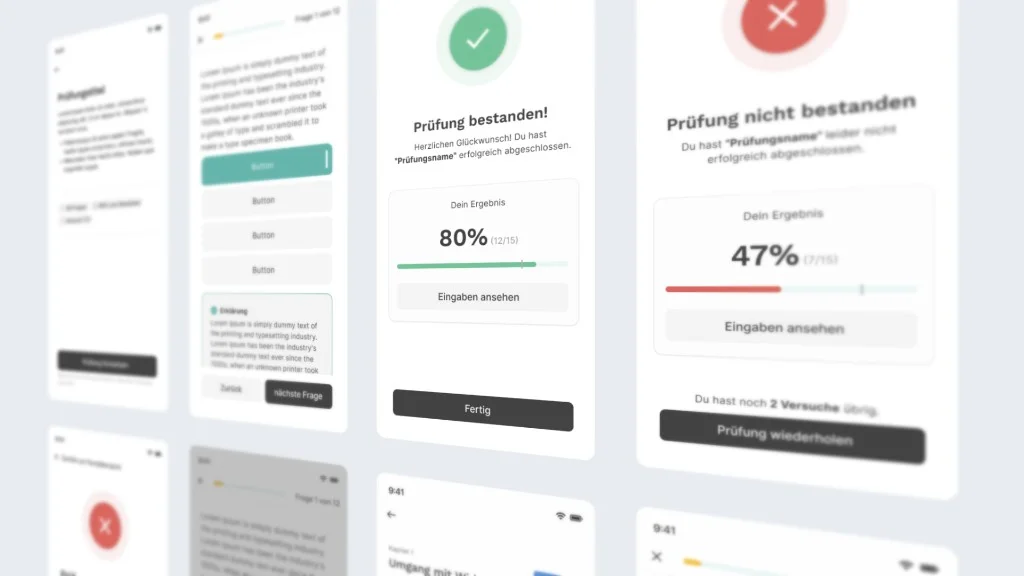
- Connected final flow — a coherent path from chapter entry through questions, instant feedback, and the final score screen.
Each round tightened the component set so engineering could implement once, not chase one-off screens.
Outcome
A reusable exam component set and one end-to-end flow that shipped into the course MVP. Learners can take chapter exams, get instant feedback on answers, and leave with a clear final score — the checkpoint the MVP was missing.
Learnings
MVP exam design is mostly scope discipline: the competitive scan was useful for vocabulary and edge cases, but the requirements pass did more to protect the ship date. Instant feedback belongs in the happy path; pass/fail copy needs as much care as the question UI.